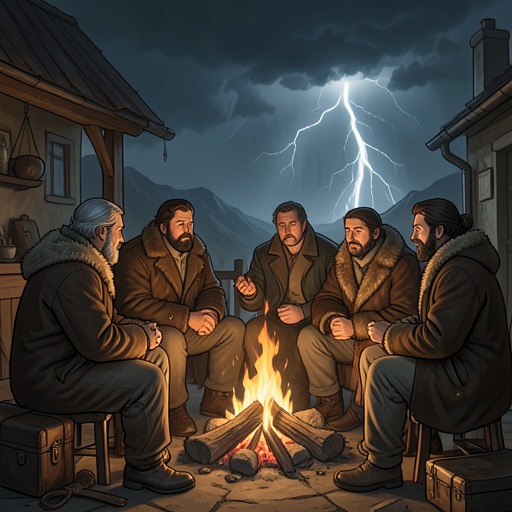
Jurchen communal ownership custom
Demi-Gods and Semi-DevilsThe Jurchen communal ownership custom is the principle that an individual’s possessions are understood as belonging to the tribe. It gives material form to the community’s shared life: wealth arriving through friendship or trade does not remain a private fortune, but can be accepted and redistributed for the benefit of the people as a whole.
Definition and Social Context
The custom is described in the account of HeLiBu’s Jurchen tribe, whose members live together and do not regard private property as separate from communal ownership. The principle does not mean that individuals cannot receive goods; rather, what one person owns is treated as belonging to the tribe as well. The narrative presents this as an ordinary feature of Jurchen life, not as a formal rule enforced by a named authority.
That collective outlook appears alongside the tribe’s hospitality toward Xiao Feng. The Jurchen welcome him despite the conflict between their people and the Khitans, and AguDa gives up his own tent for Xiao Feng and A'Zi. The custom therefore belongs to a social world in which personal acts of generosity are received within relationships among the larger community.
Gifts, Ransom, and Redistribution
The distinction between private gain and communal benefit becomes clear when a captured Khitan noble offers ransom. PoLaSu proposes increasing the payment far beyond the original offer, and the captive agrees. Xiao Feng later releases him, rejecting the idea that friendship should be measured by material reward. When the promised wealth is subsequently delivered on a far greater scale, Xiao Feng is unsure whether accepting it is appropriate, but also recognizes that refusing would disregard his sworn brother Yelu Ji’s intentions.
The goods arrive in quantities that make the gift a public event: gold, silver, brocade, grain, cattle, sheep, and horses are brought toward the Jurchen encampment. At first, the approaching livestock is mistaken for an enemy force, and HeLiBu, PoLaSu, and AguDa organize the tribesmen to meet it. Once the misunderstanding is resolved, Xiao Feng invites the Jurchens to feast on some of the animals and gives gifts to the travelling party. He then transfers the remaining wealth and livestock to AguDa for distribution among the tribe. The custom makes that redistribution intelligible: the riches do not become Xiao Feng’s private accumulation or AguDa’s personal property, but a communal benefit.
Meaning and Consequences
The tribe responds to the unexpected influx with several days of banqueting and gratitude. Its members do not find Xiao Feng’s generosity unusual under their shared-property custom; they are pleased because wealth received by one of them is understood to be available to all. The episode links hospitality and alliance to the movement of material goods, while showing how the tribe’s social arrangement determines who ultimately benefits from a gift.
The custom also contrasts with the more individualized terms of ransom and with the large-scale resources sent by a Khitan noble. Yet the account does not present the Jurchens as isolated from exchange: they receive valuable goods, host guests, and redistribute what has arrived. Their communal ownership shapes the destination of wealth rather than preventing its acquisition, making collective use—not private possession—the defining feature of the practice.